
Lights camera, Action . . . hit the play button! The music begins, DAA DAA DAADADA DAAAA DAAA [Star Wars Theme song]. Not long ago in Eastern North Carolina, one professor acknowledged traditional teaching methodologies may no longer engage contemporary students (Clarke & Adam, 2012; Schwartz, 2014).
With a Captain rrrRNnnn at the helm, pointing a crutch upwards, “Prepare for nuclear propulsion T-3…2…1.”
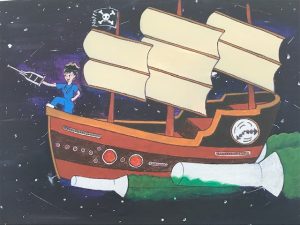
[Insert sound of rockets roaring]
Meanwhile, student passengers and fellow nurse educators were preoccupied watching a digital story about the a/R/Tograhper and how nurse educators use digital stories.
Then . . . somewhere between the orbit of Mars and Jupiter they encounter turbulence, it’s an asteroid belt!
The captain calls, “Passengers prepare the cannons. . .FIRE.” BOOM! BOOM! BOOM! With the destruction of every asteroid, the dust turned into words of different teaching methodologies.
Some . . . Morning, clear from the debris and smoke, a wormhole appears and the ship disappears.
Until now, no one knows what happened. Thankfully, this nurse specializing in Nursology, a practice and research methodology about and for phenomena and concern to nurses, (Fawcett, 2019) will share with you for the first time her findings. First, she’ll tell you what’s on the other side of the wormhole, what really happened in the asteroid belt, and lastly, the world of teaching through the lens of the A/R/Toghapher.
What’s on the Other Side of the Wormhole?
Prior to entering the wormhole, educators were just beginning to explore the use and effectiveness of immersive interactive digital entertainment, videogame playing (Squire, 2006) or as simulation educators prefer to call it, serious games, for education and the obtainment of professional goals (Whittman-Price & Price, 2015). Early studies suggest using video games, apps, and simulation-based scenarios as methodologies to increase student engagement, retention, and academic achievement (Juan et al., 2017).
What did the captain and passengers find, you ask? The flipped classroom, where teacher-created video games and interactive lessons were completed at home and students could use class time for hands-on application of learning (Tucker, 2012).
What Really Happened in the Asteroid Belt?
Back on Earth, radio waves were received and decoded. The captain deployed successful teaching strategies to thrust the ship forward. To engage pirate passengers the inclusion of case studies, in-class polling, humor, real stories, audio clips, and guest speakers as digital stories were applied to PowerPoints. Learning activities, concept maps, and simulation scenarios were created for hands-on application. Educational pins placed on virtual boards, educational bytes on Yammer, and a meet and greet in Second Life-all tried. When the hologram of Florence Nightingale failed to transmit, the captain as understudy played the part. Asteroids abolished were teaching strategies that jeopardized taking the ship off course.
World of Teaching Through the Lens of the A/R/Toghapher
What do we know about the captain? As a young child, she donned a nurse’s cap made of typewriter paper and carried a bag of medical supplies. Of no surprise in the mid-90s, she became a pirate rrrRNnnn at East Carolina University. Later, she became an educator who learned and applied the constructivist theory and made sure her students knew, knew how, showed how, and did using Miller’s Pyramid (Wittman-Price & Price, 2015). But what was she really? Besides ahead of her time. She had the epistemology and ontology of the A/R/Tograhper. The A/R/Tograher is an individual trained in the Arts, who Re-searches the world, and shares their passion through Teaching others (Irwin & Springgay, 2008).
Reflecting on the evidence
- Define the A/R/Tographer.
- Describe the author’s personal growth plan.
- Compare the author’s conceptualization of teaching and learning.
- Compose a story on your own teaching philosophy.
References
Beck, M.S. (2020, July). From the lens of the A/R/Tographer: How nurse educators use digital stories. [Paper Presentation]. Sigma’s 31st Virtual International Nursing Research Congress. Abu Dhabi. The United Arab Emirates.
Goodno, C. (2020). Intergalactic Pirate Nurse of the Stars [Commissioned Painting]. Christina Kyleen.
Clark, R. & Adam, A (2012). Digital storytelling in Australia: Academic perspectives and reflections. Arts and Humanities in Higher Education, 11(1-2), 156-157. https://doi.org/10.1177%2F1474022210374223
Fawcett, J. (2019). Nursology revisited and revived. Journal of Advance Nursing, 75(5), 919-920. https://onlinelibrary.wiley.com/doi/abs/10.1111/jan.13925
Irwin, R.L. & Springgay, S. (2008). A/R/Tograhphy as practice-based research. In S. Springgay, R.L. Irwin, C., Leggo, & P. Gouzouasis (Eds.) Being with A/R/Tograhpy. SensePublishers.
Juan, A. A., Loch, B., Daradoumis, T., & Ventura, S. (2017). Games and simulation in higher education. International Journal of Educational Technology in Higher Learning, 14(37). https://link.springer.com/article/10.1186/s41239-017-0075-9
NTCG. (2021, October 29). Some Glad Morning (feat. Chuck Wagon Gang). YouTube. https://m.youtube.com/watch?v=WTQ9Wy48Wsw
Schwartz, M.R. Neil, J.A., Scott, E.S., Peery, A.I., & Eble, M.F. (2014). A descriptive exploratory study on how nurse educators use digital stories in the classroom. The ScholarShip. https://thescholarship.ecu.edu/bitstream/handle/10342/4578/Schwartz_ecu_0600E_11261.pdf?sequence=1&isAllowed=y
Squire, K. (2006). From content to context: Videogames as designed experience. Educational Researcher, 35(8), 19-29. https://doi.org/10.3102%2F0013189X035008019
Tucker, B. (2012). The flipped classroom. Education Next, 12(1), 82-83. http://www.msuedtechsandbox.com/MAETELy2-2015/wp-content/uploads/2015/07/the_flipped_classroom_article_2.pdf
Whittman-Price, R.A. & Price, S.W. (2015). Educational theories, learning theories, and special concepts. In L.Wilson & R.A. Wittmann-Price (Eds.). Certified Healthcare Simulation Educator (CHSE™) Exam. Springer Publishing Company.
To reference this blog using 7th edition APA:
Beck, M.S. (2021, January 22). The A/R/Tographer’s teaching philosophy: The teaching version. Time Traveling Nurse. https://wordpress.com/post/timetravelingnurse.blog/205
Special Thanks
Annessa Beaman, MSN, RN, peer reviewer for this heA/R/T story, whose own teaching philosophy inspired my own.
Annah Schwartz Howell, web manager, is my super cool and endlessly talented daughter.
Peer reviewers for Sigma’s 31st Virtual International Nursing Research Congress.
 Time Traveling Nurse
Pingback: Walking with the Light – Time Traveling Nurse
Pingback: Taking of Food. What Food? – Time Traveling Nurse
Pingback: PreBrief or DeBrief: The Art Story – Time Traveling Nurse